
 Written by
The day dawned bright and sunny, and we were off to Walsingham for the Andante Study Days. Hosted at the National Pilgrimage Shrine to Our Lady, the event aims to bring together women from all over Europe, so that they can network, hear from distinguished speakers and discuss collaboratively on issues which affect women in the Catholic Church.
The journey was long, nearly 6 hours, a pilgrimage itself, however as with all pilgrimages it was as much a part of the experience as it held within it the anticipation of great things to come. On arrival we were met by two members of Cocoa, the organising committee. One from Germany and the other from Switzerland, but both with perfect English, and their welcome was warm and inviting. I knew these ladies very well, and their journey to this remote part of Norfolk had been equally as arduous as my own, but like me, they found joy when they were rewarded with the calmness of the Anglican shrine.
Over the next few hours other tired delegates arrived, and hugs, reminiscing and laughter filled the dining room as we shared our first meal. Once replenished, we were reminded that we were here to engage in convivial study, work! And so, we were shepherded into the lecture hall. This was quite small, but undeterred we shuttled around to ensure that each of us had our own space and earphones-the event had begun.
On the first evening Sophie, the co-president of Andante, spoke words of welcome, after which we were treated to a short history of the shrine and of the spiritual experience of the lady Richeldis de Faverches, without whose vision Walsingham would not exist.
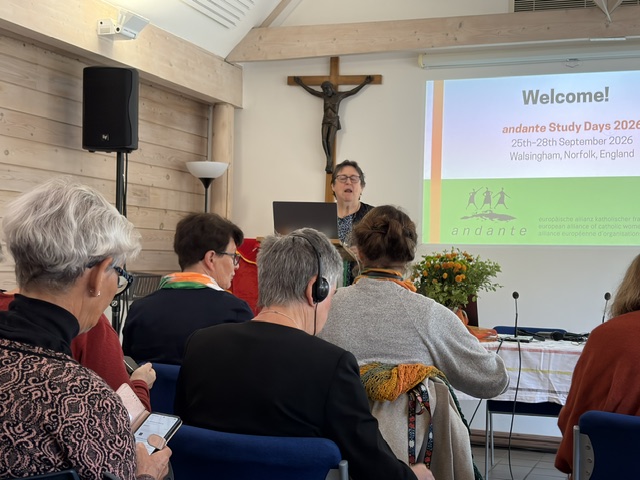
As time was at a premium, and people were very tired, we introduced our organisations in record speed of three minutes, and as eyes glazed over, the evening ended. We needed to be refreshed for the following day.
Day One
Sister Gemma Simmonds was our first speaker, and what a speaker she is. I have worked alongside her, so I knew that her talk would be stimulating and thought provoking, something I could take back to the NBCW.
Sr. Gemma is a very measured lady. She was given the title, ‘A Chance of A Lifetime’, but chose to open her talk with the words “The Future is Now” . Having this title, she cleverly managed to bring the narrative of Richeldis into the present to make the point that the Church allows women to have a vision but then prevents them from proclaiming it. In this, she was making a reference to the recent prohibition of women and lay people taking on the role of preacher, and of proclaiming the gospel. Richeldis, could have the vision, but as a lay woman, indeed as a woman, she would not be allowed in the pulpit to proclaim it. Yet pulpit on no pulpit, she has had impact -people visit Walsingham from all over the world. Sr. Gemma’s point being that women can find a way around the prohibition and have influence — my words, not Sister Gemma’s.
As an institutional movement of women, she considered Andante and other similar organisations as positive and not insignificant. Being in governance means woman can have her voice heard, even though structurally she is excluded from church ministry, she can be of influence.
While Pope Francis did many great things, in terms of women and their role, he was very influenced by the concept of the Feminine Genius – little changed for women, and women sadly are still at the mercy of machismo and clericalism. Ministry for women is still seen as a concession from the clergy. And whilst there have been many attempts to root women’s ministry in their baptism, or the relationality of the Trinity, to raise their status. The complementarity argument is still played. Women’s role stops at the sanctuary steps. Essentialism is a problem.
The Encyclical Magnifica Humanitatis she said, does have something to do with women, even though they seem absent from the narrative. Referring to the section which focuses on how technology takes on the character of everyone who uses it, she proceeded to point out that preaching and formation are similar and never neutral. Whoever is heard preaching forms the next generation and their attitudes and behaviour towards those who are not allowed to preach. Assumptions are made about the reasons for the prohibition.
The evidence is that poverty affects more women than men. If we can hear women preaching, it may have impact on their social standing. If we don’t hear women preach at the ambo, how can we raise the plight of the poor woman. As the encyclical points out humans can easily be perceived as things-objects.
She referred to the work of Dr.Phyllis Zagano to point out that women preached for centuries before it was stopped in the Latin church. Pope Francis denounced clericalism, but then argued for subsidiarity, but there is a contradiction, because surely subsidiarity would allow a local church to harness the gifts, and particularly the gifts of woman.
She then turned to Synodality and referred to the document Ecclesia Amazonia, the Final Document of the Synod of Bishops (26 October 2019), which was examined and not acted upon- indeed, we might be living through the first part, but there was a very notable element, this being that a traditional culture could talk to a progressive one. We have lived with a European model of church but this is declining, we will have to dialogue with the upcoming African churches and listen to what they are saying, and this involves women.
There were some beautiful throwaway phrases such as ‘Synodality is built in networks like Andante’ and ‘Hope is earned not assumed’. In the context of women’s ministry, we work to raise the profile of women.
Throughout her speech she was deferential to the priests and bishops. Gemma outlined the situation as it was for women, and she did this with great skill, without being judgemental.
Her talk ended, and it was time for questions. Helen asked about Lector and Acolyte and was rewarded with an assurance that the archbishop was listening.
Odds and Ends: Useful comments that we can reflect upon
Gemma commented that head teachers are at the forefront of change for women.
There is a Catholic resurgence in France- with the evident traditionalism. The Covid epidemic frightened young people to the point that when the Catholic Church tells them what to do it is comforting, they want certainty. How this will affect women remains to be seen.
As Gemma outlined earlier, there is an evident essentialism and complementarity narrative and rising traditionalism.
Sacraments should be ordinary. We have locked Christ up in the tabernacle. This was in response to a question about the domestic church. Gemma and the lady agreed that there is a divide between the church and home, but why? Would it be better if sacraments were ordinary, instead of being totally dependent on a priest, and the priest’s say so?
Mary made the point that there is a difference between governance and ordination. Why can’t women be cardinals?
Other aspects of the debate focused on clerical abuse, clerical celibacy being a fiction, no inculturation of priests coming over from African cultures where there is a different attitude towards women, and married clergy.
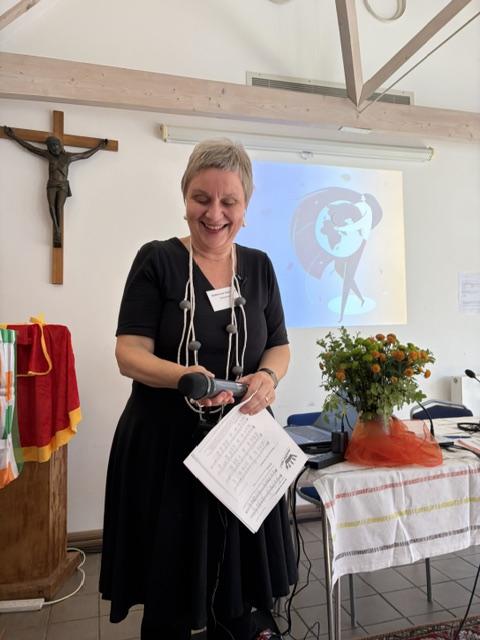
Dr Irma Stetter-Karp
Dr Irma is president of the Central Committee of German Catholics (ZdK). She has held senior positions within the church in the areas of Youth and education. She also served as director of diocesan Caritas and was Ordinariate counsellor and head of the Caritas department. Since 2020 she has served as president of the German Association for public and private welfare in Berlin.
Dr Irma set out the challenges facing the church. Essentially there is a loss of trust resulting from widespread abuse and the cover-up, which has shaped the public image of the church.
If there is progress to be made on the issue of women’s roles, this can probably only be achieved through the synodal movement worldwide. Keep in mind that there is a distinction between the movement Synodal Path and the Synodal movement. The Synodal Path in Germany, which addresses the systemic cause of abuse, is a laborious process, and reforms in the Vatican are stalling.
In the 20th and 21st centuries, the Catholic Church has failed to create a space inspired by Jesus that offers a sense of liberation. Dialogue with the world, particularly on the issue of women in questions of sexual ethics, has been neglected. The interpretation of the Second Vatican Council raises doubts as to whether it represents a hermeneutic of rupture or a hermeneutic of continuity.
The Synodal Path in Germany calls for a comprehensive gender equality within the church, which includes the ordination of women to all ordained ministries. Two scenarios are conceivable: a blockade by the Vatican, which could lead to discontent and possible divisions, or an opening up by Pope Leo, which could lead to a new beginning and a strengthening of the church’s diaconal profile. One question is to what extent women in the Church can deal with conflict and how long they are prepared to continue to exercise patience. Pope Leo sees cultural barriers to women’s equality within the church that need to be overcome but Dr Stetter-Karp questions whether this is merely a pretext. The Catholic Church has a responsibility to promote respect for the rights of all and to foster a culture of participation. The Church’s credibility is fundamentally threatened by the abuse scandal and the issue of women’s rights.
She began her lecture asking: How the Vatican can be reformed?
She, like Sr. Gemma, introduced the issue of the prohibition of preaching by the laity. In Germany women had been delivering homilies. You can find out more by reading this article: Vatican denies German bishops’ request for lay homilies, which encapsulates the current position and her lecture.
In 2023 around 500,000 people left the church. Revenues are plummeting. The global situation is worrying. The sexual abuse crisis looms large-the church is out of step with the times. Dialogue with the church over sexual ethics is not address. Diversity has not been discussed nor has gender. 96% of people want reform. This is according to: Abuse report, school guidelines: The German bishops’ busy week – BishopAccountability.org
KDK wants women’s issues addressed at the bishops’ conference. It is difficult to know if synodality has fostered the change for women.
Ludmila Javorová ordained as priest has set a precedent.
Like Gemma, Dr Stetter-Karp pointed to the Amazon synod and the hope contained within it on sacramental ministry. She is sceptical on whether women will ever be ordained, but if they are not, it is discrimination.
She posed two very good questions
- How can we envisage women in leadership in Church?
- Should there be a third Vatican Council? If so, what subjects should be discussed?
Question from the floor
How can we use the media better to promote women’s ministry in the Church?
She recognised that money is an issue and asked how women should finance the church. What would happen if women withdrew their financial support?
Sr. Gemma elaborated on the point of money. Money is diminishing, this is happening worldwide. No longer is the Church the recipient of large donations as it was before. Furthermore, there isn’t as much money being put on the plate. Organisations like Andante, and even her own Congregations in Germany, have benefited from the German church tax: Kirkensteuer, but people are objecting to having their income reduced so that the money can go to the Church. The reduction of money will impact all organisations and of their power to exert change. I’m sure that this comment resonates with us all.
Council of Europe
There followed an update from the Andante representative on the Council of Europe. Her role is essentially funded to ensure that NGOs have say in the Council of Europe. Andante’s representative engages in dialogue with other representatives in the following groups: The Gender Equality Transversal Group; The Culture, Science and Education Committee; The Human Rights Committee; The Human Rights and Religions working group.
Afternoon Workshop Sessions
These were elective and I chose the workshops:
Surprisingly different catholic. Exercising the power to define. Katharina Jost Graf, co-president of the Frauenbund Schweiz, Switzerland
Women in action: why and how Catholic women should and can contribute to social justice. Prof Dr. Maria van den Muijsenbergh, Emeritus Prof of Health Disparities. President of the Katholiek Vrouendispuut ( KVD), the Netherlands.
Surprisingly different catholic. Exercising the power to define
A group of Swiss Catholic women struggled to recruit members, and they put this down to the fact that they had the word catholic in their title. Individuals found it off-putting given the abuse scandal and the attitude of the Church to the gender issue.
The declining membership was also put down to secularism and clericalism. So, change was needed, and the change came in the way that they renamed themselves.
We were placed in groups to brainstorm the word Catholic, and what it meant: universal, sacraments etc. to make the point that Catholic was bigger than the Roman Catholic Church. As Catholic means all-embracing it is inclusive, it is bigger than partisan gender issues etc. etc. Indeed, it is ambiguous.
In my group we had some amazing discussions about the difference between religion and faith, Anglican and Catholic, state church, cultural traditions etc.
Our discussions probably mirrored those of the Swiss ladies, who eventually came up with a different title for themselves: Frauenbunde Schweiss: A Surprisingly Different Catholic.
What a difference a name change makes. They now have over a thousand members; they are inclusive of different denominations and genders. They have religious houses included in their membership and are supported by the Cardinal. Are they Catholic? They would argue, yes.
More information on their group is available here: Switzerland’s largest Catholic women’s group drops ‘Catholic’ from name – EWTN Ireland – Catholic Television for Ireland
Women in action: why and how Catholic women should and can contribute to social justice
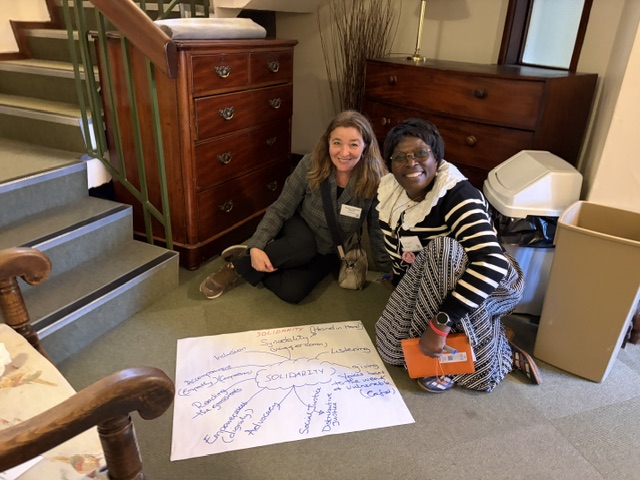
Professor Maria, who led the session, spoke of her experience in medicine and how it became more compassionate when she embraced the principles of Catholic Social Teaching. So, the session explored CST, indeed we were to do the work. So we were put into groups.
One group had dignity, the other subsidiarity, and my group were given the word solidarity. Basically, we had to brainstorm everything we could think of associated with the term. We fed back into the main group, but this was quite rushed as the facilitator had to leave to get a plane back to the Netherlands.
The exercise was a good refresher, and an opportunity to really think about the principles in action. It is notable that the press is full of our prime minister’s adoption of CST. It has the power to transform.
Evening Celebrations
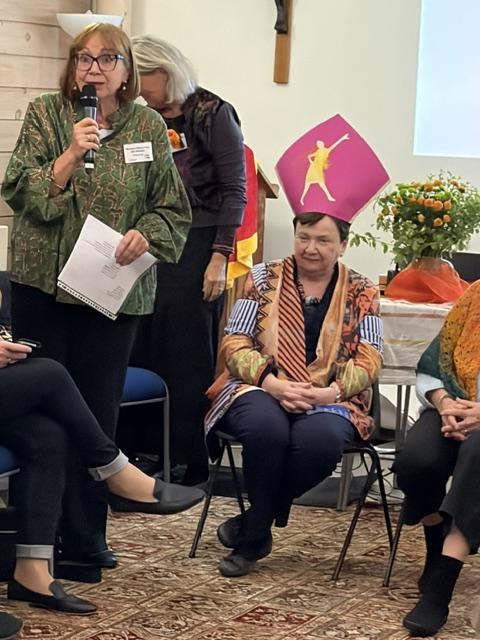
In the evening we celebrated 20 years of Andante. And Dr. Mary McHugh, who had previously uttered to me that there is no theology for a mitre, was promptly crowned with a mitre; an appreciation of her being one of the first presidents. Each president in turn gave their experience, and to see them all wearing mitres was quite funny. Even lovely Celia managed to get in on the act!
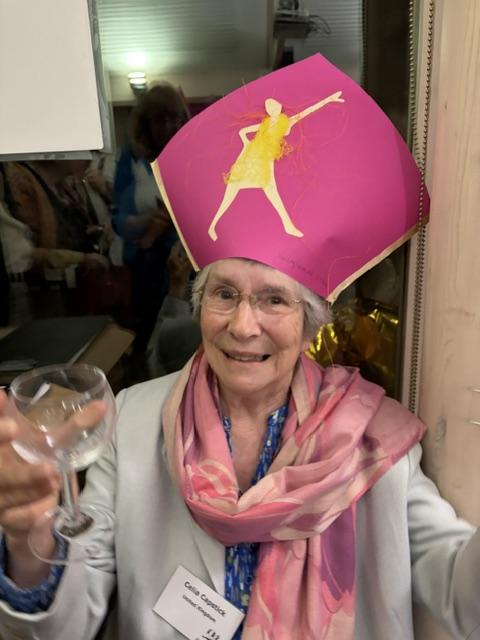
The evening finished with a celebratory drink and a cultural food share.
I stood outside for a short while as there was a torchlight procession, and I thought it remarkable that in a room where women were celebrating 20 years, outside a group of pilgrims were singing Ave Maria in honour of the greatest of women. Our Lady gets everywhere- even to the Andante conference! I hope she was impressed.
Jacintha Bowe
NBCW President